The University of North Carolina at Chapel Hill
A mission for pure discovery: UNC launches a new opportunity for archaeological fieldwork and research
November 9, 2026
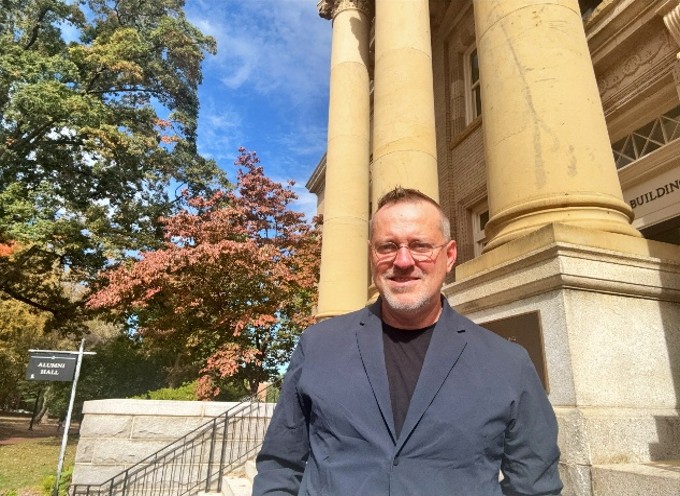
Chris Moore ’94 in front of Alumni Hall, the main building that houses the archaeology program and research labs
Chris Moore’s career as a biotechnology executive has always embodied the values of innovation and transformative research. Whether it be spearheading new discoveries that may cure cancer or keeping display cases of historical artifacts at home that provide insight into past societies, Moore keeps these values at the forefront of his efforts. “What I’m really interested in is pure discovery. That’s what I love,” he said.
Mirroring Moore’s passion for pure discovery as a biotechnology executive is his lifetime love of archaeology. “I was interested in digging in the dirt and finding things,” he said. Archaeological ventures began during his childhood with his dad, Brooks F. Moore. Moore reflected, “He was the first person to take me out to a plowed field in Concord, N.C., and I found my first arrowhead when I was like 9. I have thousands of them at home now.” The Brooks Moore Field Discovery Fund in Archaeology, a generous gift intended to support field research in UNC’s archaeology program, is named after Moore’s father. “I was thinking about how I can honor him and what we used to do together,” Moore said.
The Brooks Moore Field Discovery Fund in Archaeology will support fieldwork projects that involve direct, on-the-ground investigation, with emphasis on innovative, high-risk projects that are unlikely to receive support through traditional funding mechanisms.
Jon Marcoux, director of the renowned Research Laboratories of Archaeology at UNC, said, “Like many science fields, archaeology is navigating a very challenging funding landscape following recent cuts to federal research support. The Brooks Moore Fund will fill a very crucial need in our field. It will support ambitious, forward-thinking projects that emphasize the development and application of new technologies and research methods and the generation of new fields of knowledge within archaeology.”
“I want to directly help the department and specifically the primary investigator who has an idea for a dig somewhere. I want it to be specifically for projects that they wouldn’t otherwise do,” Moore said. “That is the root of pure discovery.”
Moore’s gift also encourages collaboration. He said, “Probably what is equal to my love of discovery is my love of collaboration. I think the best science comes from purely collaborative efforts.” During fieldwork, students and their principal investigators are encouraged to draw insights from geologists, historians, paleontologists and other experts that will enhance how new primary data is interpreted. This supports the department of anthropology in promoting interdisciplinary study through its subfields, including the archaeology curriculum and associated research. “We are very excited to see how this support will help our faculty conduct groundbreaking fieldwork that will become the standard for archaeological research and education for decades to come,” Marcoux shared.
In addition to transformative discovery, Moore’s generosity is fueled by his deep Carolina roots. He received his undergraduate degree from UNC-Chapel Hill with a biology major and chemistry minor. As a student, he worked as a paramedic for the South Orange Rescue Squad of Orange County, helping start the technical rescue team. He also worked at the Frances Owen Blood Research Lab at UNC Chapel Hill doing research on hemophilia. The lab was founded and led at the time by Dr. Kenneth Brinkhous, a pioneering pathologist whose career inspired Moore to devote his life to scientific discovery. After his undergraduate studies, he went to North Carolina State University for his master’s and Ph.D. in immunology and then returned to Chapel Hill for his postdoctoral fellowship under the mentorship of Dr. Jenny Ting, distinguished professor of genetics at the UNC School of Medicine. He presently serves as an advisory board member of both the UNC Eshelman Institute for Innovation and Innovate Carolina.
Furthermore, Carolina is a university beloved by Moore’s entire family, including his wife, Jennifer Moore ’94, and their three children. Their daughter, Ella Moore ’27, is an archaeology major who spent the summer of 2026 finding artifacts from a Mayan settlement in Belize. The project was an opportunity for her to engage her own passion for discovery and celebrate her grandfather’s legacy. Their other children, Ryder Moore and Cooper Moore, also value innovation and creativity, with aspirations to attend UNC.
Evidently, the resounding themes of Moore’s generosity are his love for pure discovery and love of Carolina. His present work as Chief Scientific Officer at XenImmune Therapeutics, a company that applies organ transplant hyperacute rejection to fight cancerous tumors, propels this mission. Moore’s generosity empowers the College of Arts and Sciences to provide students with academic, extracurricular and research opportunities. Moore concluded, “I’d love to see the University embark on things that are quite transformative, contributing new ideas to the field of archaeology. There are so many things left to be found out there… I want them to discover something.”
By Kennedy Collins, M.A. ’25