Classics professor shares thoughts on ‘The Odyssey’
July 20, 2026
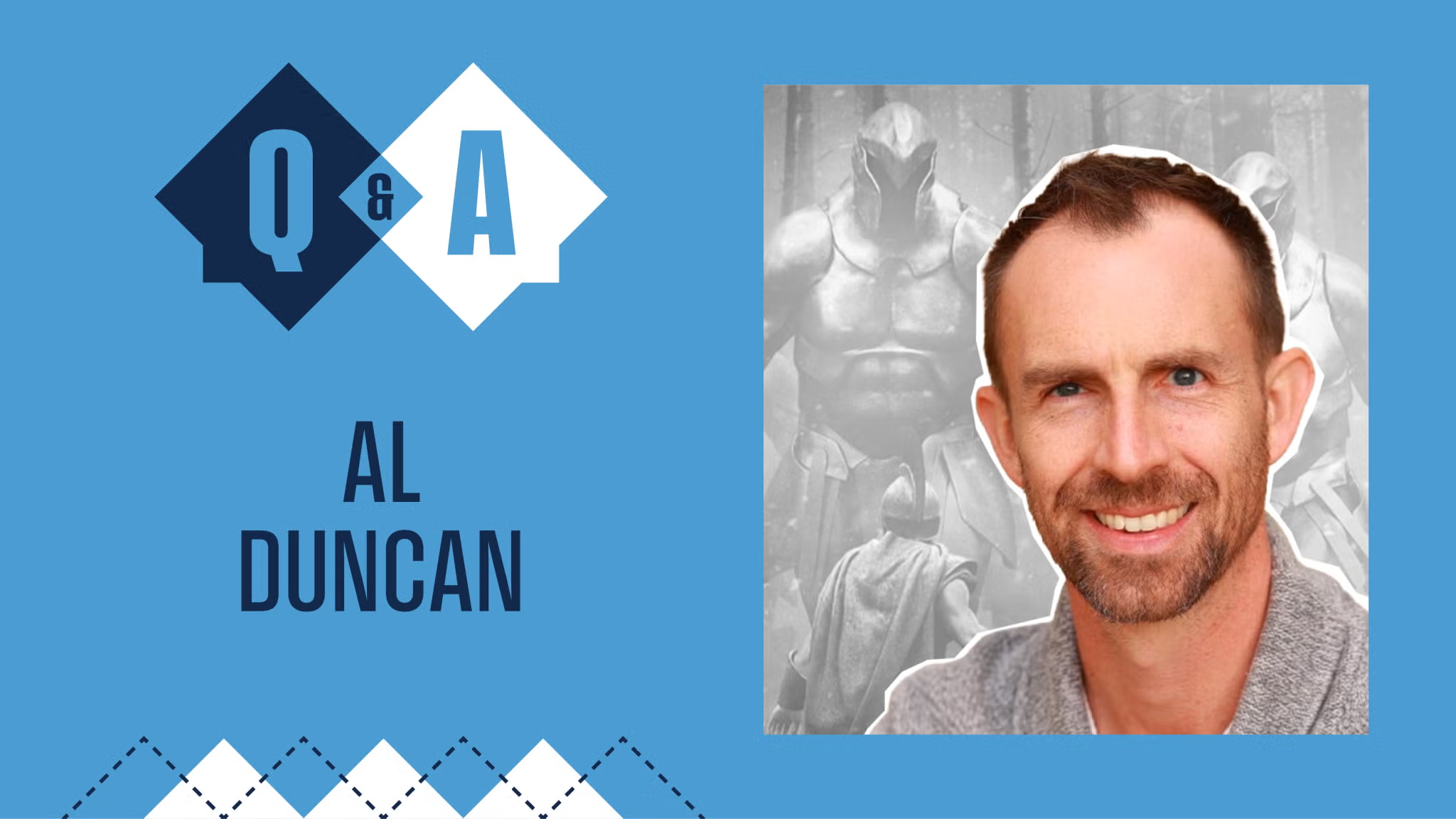
Professor Al Duncan welcomes the upcoming film and how it will introduce new audiences to the ancient Greek tale.
Editor’s note: Duncan was the Bernstein Faculty Fellow at the Institute for the Arts and Humanities in spring 2026 and also received an award from the Morris Family Faculty Fellowship Excellence Fund. He has gotten support from the William C. Friday Fund for Student and Faculty Leadership to his work with an undergraduate student and received research funding from the Cathy and Art Rollins Faculty Excellence Fund.
By Josh McCormack, University Communications and Marketing, Wednesday, July 15th, 2026
With the blockbuster film adaptation of “The Odyssey” hitting theaters July 17, historians and ancient Greek mythology scholars are anticipating renewed interest in the classic story among younger audiences.
Al Duncan, associate professor in the UNC College of Arts and Sciences’ classics department, is eager to see the film and how it might affect cultural discussion around Homer’s 3,000-year-old epic poem.
Duncan shared his thoughts on the movie, its online reception and how film and television can be effective tools for introducing these classic stories to new generations.
When did you first discover “The Odyssey”?
Funny enough, it was an NBC television miniseries. I’m a millennial, and this was in the 1990s with Vanessa Williams as Circe and Armand Assante as Odysseus. That was actually one of my first exposures to the ancient Greek world.
While I eventually learned to love the original story once I read it in high school, that miniseries sparked an interest in classic myths for me.
For many younger audiences, the upcoming film adaptation of “The Odyssey” will be their introduction to Homer’s epic poem. How do you feel about that?
I feel great about it. “The Odyssey” is something that has been passed down through oral traditions, and we don’t know if Homer was one person or a group of individuals over the centuries. There have always been reinterpretations of the story.
The fact that it’s still resonating 3,000 years later is incredible. I feel great that there are still new points of entry for new audiences.
There has been much discussion of “historical inaccuracies” leading up to “The Odyssey,” particularly regarding the casting. What do you make of that?
I do find it ironic that there are seemingly no Greek actors in the cast. Aside from that, I welcome the broad representation in the diverse cast that some people seem to have taken umbrage with.
Homer believed that the gods traveled to Europe, Africa and all across the western Mediterranean, so I think the cast represents the universality of the tale.
What do film adaptations of classic myths often get wrong?
I think they actually get a lot right because they connect with people in the moment and with the things that interest them. “The Odyssey” survived because people liked hearing this story. It was the movies, the podcasts or the video games of its era, so for it to find its way into those forms of media today feels completely appropriate to me.
But if the adaptations lose one thing, it’s often the poetry and sublimity of the original work. A fast-paced film isn’t going to capture some of the moments of pathos or the emotional highs that you get from reading the text.
What should viewers keep an eye out for in “The Odyssey”?
I’d encourage audiences to pay attention to what makes Odysseus both extraordinary and deeply human. At its core, “The Odyssey” is about “nostos” — the Greek concept of returning home after war — and the choices Odysseus makes along the way. His wit, bravery and recklessness can seem larger than life, but they’re also qualities we recognize in ourselves. More than anything, I’d encourage people to follow whatever captures their attention. The beauty of the ancient classics is that they’re so rich and complex that people are still finding new ways to interpret them thousands of years later.
 The University of North Carolina at Chapel Hill